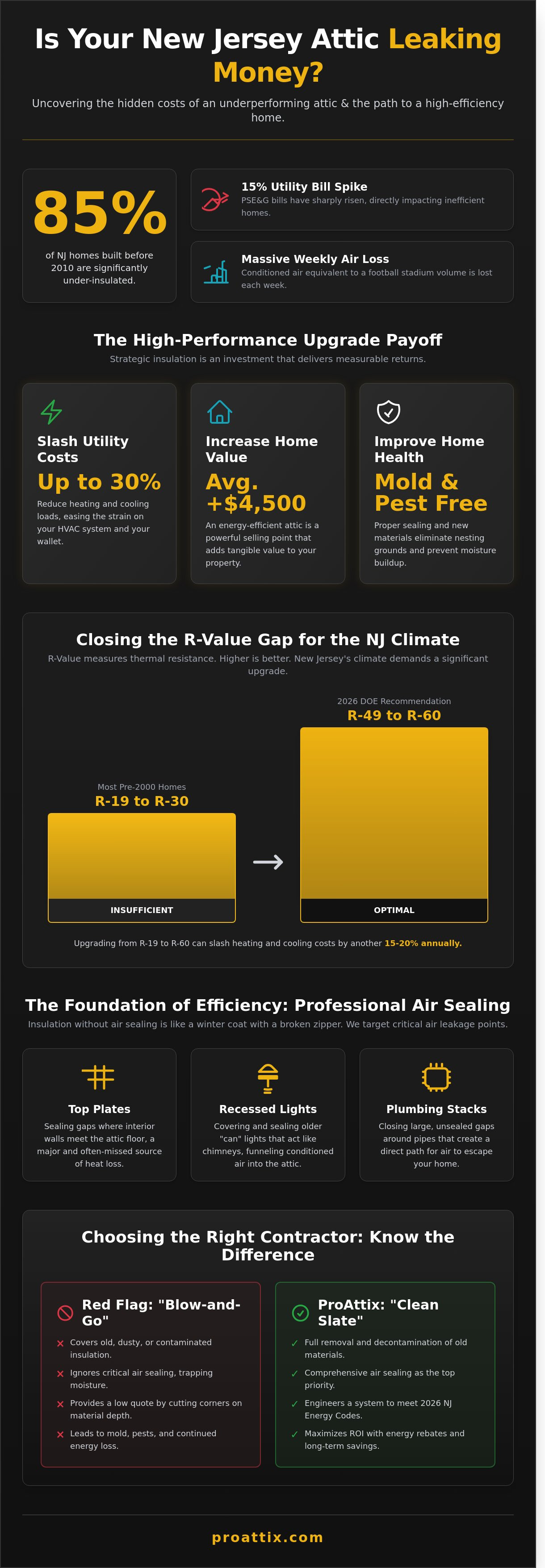
Did you know that 85% of New Jersey homes built before 2010 are currently losing enough conditioned air through their attics to fill a professional football stadium every single week? You probably feel this reality every time you look at a PSE&G bill that has spiked by 15% since last winter. It's a common frustration to deal with drafty second floors or the unsettling suspicion that your old insulation has become a nesting ground for pests. Working with the most qualified attic insulation contractors NJ offers is the only way to transform your home from a thermal sieve into a high-performance asset.
We understand that you want more than just a quick fix; you're looking for a strategic partner to optimize your home’s energy architecture. This 2026 guide will teach you how to select a contractor who delivers measurable results, helping you slash monthly utility costs by up to 30% while securing a mold-free environment. We'll analyze the latest technical standards for air sealing and high-R-value materials that can increase your home's resale value by an average of $4,500. By the end of this article, you'll have a clear roadmap to a more efficient, comfortable, and durable New Jersey home.
Key Takeaways
- Learn how New Jersey’s 2026 energy codes impact your home’s value and why specialized expertise is required to meet these new residential standards.
- Discover why achieving an R-49 to R-60 thermal rating is essential for the NJ climate and how to choose between high-density cellulose and fiberglass.
- Understand the "Clean Slate" philosophy of professional attic insulation contractors NJ, focusing on full decontamination and removal of old materials before new installation.
- Maximize your investment by leveraging 2026 NJ energy rebates while protecting your roofing from costly ice dams and heat-related degradation.
- Identify critical red flags like "blow-and-go" tactics and learn why professional air sealing is the foundation of a high-performance attic system.
Why NJ Homeowners Need Specialized Attic Insulation Contractors
New Jersey’s residential landscape is entering a period of rapid transformation. By early 2026, the state’s adoption of the 2021 International Energy Conservation Code (IECC) will set a new baseline for residential thermal performance. This regulatory shift makes the role of specialized attic insulation contractors NJ more critical than ever. These experts don't just blow in material; they engineer a high-performance barrier that protects your investment from the state’s notoriously volatile weather patterns. Your attic serves as the lungs of your home. When it fails, your budget feels the pressure. Data from local utility providers shows that PSE&G and JCP&L rates have seen consistent upward adjustments, with some residential service categories seeing 5% increases in a single year. A strategic insulation upgrade can reduce heating and cooling loads by 20% or more. Without professional intervention, your HVAC system works 30% harder than necessary, shortening its lifespan and inflating your monthly bills. We view your home as a single, integrated system where the attic acts as the primary thermal regulator.The New Jersey Thermal Challenge
Standard fiberglass batts frequently fail in North Jersey’s older housing stock, much of which was constructed before 1970. These materials often sag or gap over time, leaving your home vulnerable to drafty winters. In Central Jersey, summer humidity levels frequently exceed 75%, creating a breeding ground for attic mold if ventilation is mismanaged. Understanding R-Value is the first step in selecting materials that can withstand these extremes. A thermal bypass is a hidden gap or path that allows air to circumvent your insulation, which can drain 15% of your home's total energy efficiency.Beyond the Fluff: The Importance of Air Sealing
Adding layers of insulation without proper air sealing is like wearing a heavy wool sweater in a windstorm without a windbreaker. It won't keep you warm. Professional attic insulation contractors NJ prioritize sealing the top plates, recessed lighting canisters, and plumbing stacks that pepper your attic floor. These are the primary exit points for the air you've already paid to heat or cool.- Top Plates: The narrow gaps where interior walls meet the attic floor, often overlooked by DIYers.
- Recessed Lights: Older "can" lights that act as chimneys, sucking conditioned air into the attic.
- Plumbing Stacks: Large holes cut for pipes that often go unsealed during original construction.
Understanding R-Value and Material Choices for the NJ Climate
New Jersey sits in a demanding climate zone where winters are freezing and summers are stiflingly humid. To combat these extremes, the Department of Energy recommends an R-value between R-49 and R-60 for most local attics. This number represents the material's thermal resistance. A higher R-value means better heat retention. Most homes built before 2000 in areas like Princeton or Morristown likely have R-19 or R-30, which is insufficient for modern efficiency standards. Increasing this to R-60 involves installing roughly 16 to 20 inches of high-quality material. Calculating ROI: Energy Savings is a straightforward process when you consider that moving from R-19 to R-60 can slash heating and cooling costs by 15% to 20% annually.
Choosing the right medium is a structural decision that impacts more than just temperature. Experienced attic insulation contractors NJ analyze the home's "breathability" before recommending a product. If a 1940s colonial is sealed too tightly without a proper ventilation strategy, moisture trapped in the attic can lead to structural rot or mold growth. The goal isn't just to stop heat; it's to manage the entire attic ecosystem. Material choice dictates how your home handles the 65% average humidity levels found in the Garden State.
Blown-In Cellulose: The Eco-Friendly NJ Favorite
Cellulose consists of 85% recycled paper fiber treated with borates. These minerals provide a Class 1 fire rating and serve as a powerful pest deterrent. From an architect's perspective, density is the primary metric for success. We measure "settled density" to ensure the R-value remains consistent for 25 years or more. In a typical 1,200-square-foot NJ attic, cellulose offers a superior cost-benefit ratio. It fills irregular gaps around old floor joists and electrical boxes better than pre-cut batts ever could. This creates a seamless thermal blanket that eliminates the "chimney effect" common in older suburban homes.
Fiberglass and Mineral Wool Options
Standard fiberglass attic insulation remains a staple for modern builds with uniform joist spacing. It's lightweight and naturally non-combustible. However, DIY installations often fall into the "compression trap." If you squeeze a fiberglass batt to fit a tight space, you destroy the air pockets that provide the insulation. A 1-inch gap or a 10% compression rate can reduce the effective R-value by 25%. For homeowners near high-traffic corridors like the Garden State Parkway, mineral wool is an excellent alternative. It withstands temperatures up to 2,150°F and provides exceptional acoustic dampening, making it the top choice for fire safety and soundproofing.
Spray foam offers the highest R-value per inch, but it's a permanent architectural change. It creates a "hot roof" by sealing the underside of the roof deck. This is effective for finished attics but requires precision to avoid trapping moisture against the roof sheathing. If you aren't sure which material fits your rafters, you can request a technical attic assessment to identify your specific thermal weak points. Every home requires a customized strategy to ensure long-term structural health and maximum energy efficiency.
The ProAttix Process: Remediation, Cleaning, and Installation
We don't build on a broken foundation. Our "Clean Slate" philosophy dictates that every successful thermal upgrade begins with the total removal of existing materials. Many homeowners ask if they can simply layer new product over the old. The answer is a firm no. Over 40% of a home's energy loss occurs through the attic, and you can't fix air leaks or structural gaps if they're buried under decades of dusty, compressed filler. As leading attic insulation contractors NJ, we've seen that "topping off" only traps moisture and hides existing mold or pest issues, eventually leading to structural rot.
Our decontamination protocols are rigorous. If your attic has a history of rodent activity, the old material is a biohazard. Rodent waste contains pheromones that act as a beacon for future infestations, even after the entry points are sealed. We treat the entire space with an EPA-approved, botanical disinfectant that neutralizes odors and pathogens at a molecular level. This ensures the air circulating through your home is sterile and safe. We minimize disruption to your NJ home by using heavy-duty plastic tunneling from your front door to the attic hatch, ensuring that 100% of the debris stays contained within our filtration system.
The ProAttix workflow follows a strict engineering sequence to ensure maximum ROI. Once the space is empty, we perform detailed air sealing. We use expanding foam to plug "top plate" gaps, wire penetrations, and plumbing stacks that act like chimneys for your expensive heated air. Only after the attic is airtight and decontaminated do we begin the installation of new material. We conclude every project with a 15-point inspection, including a thermal imaging scan to verify that the new barrier is seamless and free of "hot spots" where heat could escape.
Old Insulation Removal and Decontamination
Leaving rodent-soiled material in your ceiling is a liability for your family's health. We use an industrial 15,000 CFM vacuum located outside the home to extract every gram of old material through a 6-inch diameter hose. This process is entirely dust-free, protecting your indoor air quality during the transition. Degraded fiberglass dust contains microscopic glass shards that, when inhaled, can cause permanent scarring of lung tissue and chronic respiratory inflammation. Our high-velocity extraction ensures these particles never enter your living room or bedrooms.
Precision Installation and Quality Control
Achieving a consistent R-49 to R-60 thermal rating requires mathematical precision. We install depth markers every 10 feet to ensure our crews maintain a level 15-inch depth across the entire attic floor. Proper airflow is just as critical as the insulation itself, so we install high-density baffles at every rafter tail. These baffles prevent the new material from clogging your soffit vents, which maintains the cross-ventilation necessary to prevent ice dams in the winter and shingle damage in the summer. Our final thermal scan provides visual proof that your NJ home is now a closed, efficient ecosystem.
Calculating ROI: Energy Savings and NJ Rebates in 2026
Investing in your home's thermal envelope is a financial decision as much as a structural one. In 2026, New Jersey residential energy rates remain among the highest in the Northeast, making efficiency a top priority for fiscal responsibility. Professional attic remediation typically yields a 22% reduction in annual heating and cooling expenses. For a standard 2,000-square-foot home in Edison or Cherry Hill, this translates to roughly $650 to $900 in annual savings based on current utility projections. These figures represent a guaranteed return on investment that outperforms most traditional market accounts while shielding you from future rate hikes.
The math behind these savings relies on the elimination of the "stack effect." During NJ winters, warm air rises and escapes through unsealed gaps in your attic floor. This forces your furnace to work 35% harder to replace that lost heat. By hiring the attic insulation contractors NJ homeowners rely on for precision air sealing, you stop this cycle. We focus on the mechanical bypasses, such as recessed lighting and plumbing stacks, where 70% of heat loss actually occurs. This technical approach ensures that the R-60 cellulose or fiberglass we install performs at its maximum laboratory-rated efficiency.
Protecting Your Roof and Gutters
Thermal leakage does more than inflate your bills; it actively degrades your home's exterior. During New Jersey winters, heat escaping into the attic melts snow on the roof, which then refreezes at the eaves. This cycle creates ice dams that tear away your gutter systems and cause internal leaks. By maintaining a cold roof deck through proper insulation and ventilation, you protect the structural integrity of your asphalt shingles and prevent plywood rot in the roofing deck. A stable attic temperature can extend the functional lifespan of your roof by 5 to 8 years, saving you over $15,000 in premature replacement costs.
NJ Specific Incentives and Financing
The 2026 NJ Clean Energy Program offers aggressive incentives for homeowners who prioritize efficiency. Through the Home Performance with ENERGY STAR® initiative, New Jersey residents can access tiered rebates. Projects that achieve a 20% or greater reduction in total energy usage often qualify for rebates up to $5,000. Additionally, the federal Energy Efficient Home Improvement Credit (Section 25C) remains a vital tool, providing a 30% tax credit up to $1,200 annually for weatherization and insulation upgrades.
- NJCEP Rebates: Cash back incentives based on measured post-installation energy performance.
- Federal Tax Credit: A direct reduction of your tax liability, capped at $1,200 for 2026 projects.
- 0% Financing: Many NJ utility providers offer on-bill repayment programs with 0% APR for up to 10 years for qualified efficiency upgrades.
When you work with certified attic insulation contractors NJ, they provide the necessary performance testing and documentation required for these filings. Most projects reach a "break-even" point within 3.5 to 5 years. Beyond the immediate cash flow, high-efficiency homes in the 2026 real estate market command a 3.2% price premium. Data from the National Association of Realtors suggests that energy efficiency is now a top-three priority for buyers. A well-insulated attic is a clear signal of a well-maintained, low-overhead property that stands out during a home appraisal.
How to Choose the Right NJ Attic Insulation Contractor
Selecting from the sea of attic insulation contractors NJ offers requires a shift in perspective. You aren't just buying bags of fiberglass; you're investing in a thermal boundary for your home's ecosystem. Many homeowners fall into the trap of hiring "blow-and-go" contractors. These outfits focus on speed, often skipping the critical step of air sealing before adding material. Without air sealing, your new insulation acts as a giant, expensive air filter, allowing 40% of your conditioned air to leak through bypasses around light fixtures and plumbing stacks. If a contractor doesn't mention the "stack effect" or air sealing in their first five minutes, they're likely sacrificing your long-term ROI for a quick turnaround.
A superior contractor views the home through an "Architect" mindset. This means treating the attic as a complex intersection of thermodynamics and structural integrity. In New Jersey, where humidity levels often exceed 70% in July and temperatures drop below 20 degrees in January, a generic approach fails. You need a partner who understands regional building codes and the specific challenges of 100-year-old Victorian homes in Montclair or mid-century split-levels in Cherry Hill. Precision is the only metric that matters here. A 5% gap in your insulation layer can lead to a 50% drop in overall R-value efficiency.
Credentials and Local Authority
Legitimacy starts with the NJ Division of Consumer Affairs. Every contractor must maintain a valid NJ Home Improvement Contractor (HIC) registration, as mandated by N.J.S.A. 56:8-136. Verify these numbers before signing any agreement. Look for teams that engage with the community at events like the 2024 Garden State Home Show. This local presence ensures accountability that national franchises often lack. ProAttix operates with an engineering-led philosophy; we don't just fill space. We analyze the attic-to-roof relationship to prevent ice damming and moisture buildup, ensuring your home's skeleton remains dry and protected for decades.
- Insurance: Ensure they carry at least $1 million in general liability and full workers' compensation.
- Certifications: Ask if their technicians are BPI (Building Performance Institute) certified.
- References: Request three case studies from your specific county to verify regional expertise.
Getting Your Free NJ Attic Quote
A professional inspection is a diagnostic event, not a sales pitch. If a contractor spends less than 30 minutes in your attic, they haven't seen the whole picture. A comprehensive assessment must include a check of the baffles, a moisture reading of the roof deck, and a thermal scan of the ceiling joists. This data-driven approach allows for project-based fees rather than unpredictable hourly rates. Project-based pricing protects you from "hidden" complexities that often arise once the work begins. It shifts the risk from the homeowner to the contractor, where it belongs.
When you review your quote, look for a line-item breakdown of materials and labor. You should see specific R-value targets and a plan for mechanical ventilation. This transparency is the hallmark of a strategic partner rather than a mere vendor. Your home's efficiency is a math problem; make sure your contractor has the right variables. Ready for a healthier home? Schedule your ProAttix attic assessment today and experience the precision of an engineering-led thermal upgrade.
Secure Your Home’s Efficiency for 2026 and Beyond
Your attic's performance dictates your home's comfort and your monthly expenses. Upgrading to R-60 insulation can slash your heating and cooling costs by up to 20% this year. The 2026 New Jersey energy rebates make this the ideal window to move from outdated fiberglass to high-performance spray foam or cellulose. Choosing the right attic insulation contractors NJ homeowners trust ensures you don't just add material, but solve underlying airflow issues. ProAttix brings a Chatham-based engineering perspective to every project. We don't just blow in insulation; we execute a full-scale remediation and architectural sealing process. Our team treats your attic like a critical component of your home's structural health. You'll see the difference in your first utility bill. Don't let your hard-earned money leak through your roof. You've got the data and the 2026 roadmap. Now it's time to build a more resilient, cost-effective home.
Get Your Professional NJ Attic Insulation Quote from ProAttix
Frequently Asked Questions
How much does attic insulation cost in New Jersey for a standard 1,500 sq ft home?
Insulating a 1,500 square foot attic in New Jersey typically costs between $2,500 and $5,500. This price range covers standard materials like blown-in cellulose or fiberglass. If you choose high-performance closed-cell spray foam, your investment might reach $7,500 or more. Professional attic insulation contractors NJ provide these estimates based on your specific roof pitch and the depth of material needed to meet local codes. These upgrades usually pay for themselves through 20% savings on annual energy bills.
Does NJ offer rebates for attic insulation in 2026?
New Jersey homeowners in 2026 can access rebates up to $4,000 through the NJ Clean Energy Program's residential initiatives. You're also eligible for the federal Energy Efficient Home Improvement Credit, which provides a 30% tax credit capped at $1,200 each year. We view these incentives as a way to turn a necessary maintenance task into a high-ROI customized solution for your property. Always verify current tier requirements on the official NJCEP website before you sign a contract.
Is it better to remove old insulation or just add more on top?
You should remove old insulation if it's compressed, moisture-damaged, or shows signs of a 10% or higher rodent infestation. Adding new material over contaminated or wet layers traps allergens and reduces your home's total thermal efficiency. If your existing fiberglass is dry and clean but simply thin, "topping off" is a cost-effective strategy to reach modern standards. A professional assessment ensures your long-term partnership with energy efficiency begins with a healthy, structural foundation.
How long does the attic insulation installation process take?
A standard attic insulation project takes between 4 and 8 hours to complete for most New Jersey homes. If your project requires the removal of 20 year old material or extensive air sealing, the timeline might extend to 12 hours over two days. Our teams prioritize a structured 6-step workflow to minimize disruption to your household. We aim for single-day delivery in 90% of residential cases to maintain high operational efficiency.
Can new insulation help with the mouse problem in my NJ attic?
New insulation effectively deters mice when you combine pest-resistant materials like borate-treated cellulose with professional air sealing. Borate-treated products have a 99% success rate in repelling insects and creating an inhospitable environment for rodents. Most attic insulation contractors NJ use spray foam to plug small gaps that serve as entry points for pests. This dual-action approach protects your home's structural integrity while significantly improving your indoor air quality.
What is the best type of insulation for New Jersey’s high humidity?
Closed-cell spray foam is the superior material for managing New Jersey's 70% average summer humidity levels. It creates a seamless vapor barrier that prevents moisture from condensing on your wooden rafters and causing mold. Mineral wool is another excellent alternative because it's naturally hydrophobic and maintains its R-value even when exposed to damp air. Selecting these moisture-resistant materials provides a future-proof shield against the Garden State's volatile coastal climate.
What is the recommended R-Value for attics in North and Central Jersey?
The Department of Energy recommends an R-Value of R-49 to R-60 for homes located in New Jersey's Climate Zones 4 and 5. Reaching this benchmark typically requires 15 to 20 inches of blown-in cellulose or fiberglass. Achieving these specific thermal resistance levels can reduce your heating and cooling loads by 15% immediately. It's a precise engineering requirement that ensures your HVAC system doesn't work overtime during extreme January freezes or July heatwaves.
Will new attic insulation prevent ice dams on my roof this winter?
Proper attic insulation prevents ice dams by keeping your roof deck at a consistent, cold temperature throughout the winter. When heat stays inside your living space instead of escaping into the attic, snow doesn't melt and refreeze at the gutters, which causes 90% of winter roof leaks. Effective air sealing is a critical part of this process. By stopping warm air bypasses, you protect your shingles and extend the lifespan of your entire roofing system.